
Rules engine
What is the rules engine?
The rules engine lets you automatically fill and update table cells based on rules, instead of entering data manually.
It reads data from your own tables or from your partners’ tables, applies your business rules (mappings, formulas, conditions), and then writes the right value in the right place.
Why?
Product data usually exists in many places (ERP, PIM, supplier catalogs, retailer requirements), and teams end up copy/pasting the same information across tables and partners. This creates:
- duplicated work
- inconsistencies between catalogs and partners
- slow updates when a source value changes
- manual fixes and avoidable errors
The rules engine solves this by letting you define repeatable rules once, so Product‑Live can apply them consistently and keep your data aligned over time.
By connecting Product-Live to your systems, or using Product-Live as your main data source, you can map your attributes to your partners’ attributes so you avoid duplicate work and reduce errors.
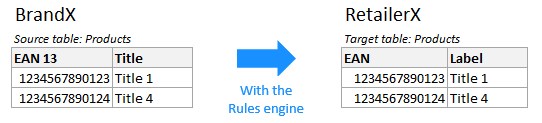
This documentation presents two solutions for two distinct use cases:
- Map fields (between tables): copy/transform data from a source table into a target table (typically supplier → retailer).
- See: Map fields and Mapping use cases.
- Automate fields (inside one table): compute/update fields from other fields in the same table (formulas, derived values, consistency helpers).
- See: Automate fields and Automation use cases.
In practice, suppliers and vendors use mappings to keep multiple catalogs in sync, and automation to keep computed fields consistent inside their own tables.
Map fields
Field mapping execution on target tables is asynchronous and executed on demand, which means that an administrator must configure the periodicity of the execution of the rules. Usually Product-Live team has configured a periodic execution done during the night. If you want to learn more contact Product-Live support.
You can also select a list of items and directly applying the rules, but for this your administrator must have configured an action. If you want to learn more contact Product-Live support.
How mappings run
In short
- Rules Engine mappings: executed on demand and/or scheduled (often nightly).
- When multiple mapping rules target the same field, only the first matching rule executes (evaluation stops after the first match).
Methodology
Please consult the following document for best practices Mapping Methodology (French version).
Mapping evaluation order
- Rules are evaluated in order; the first rule that matches runs and later rules for that target field are skipped.
- If a rule updates a field, subsequent rules in the same run would see the updated value—but for mappings the run stops after the first match for that target field.
When mappings run
- Target tables: execution is asynchronous (on demand and/or scheduled, often nightly).
- You can also apply rules to a selected list of items if an action is configured.
Mapping use cases
Mapping rules often cover common scenarios (type conversions, option/category mapping, multi-field logic).
Follow these links to see examples and best practices: Mapping use cases
Setup field mapping
This guide is split into two steps:
- Setup link between tables: connect the target table to one (or more) source tables and choose a pivot identifier.
- Create mapping rules: configure the action and (optional) conditions for a target field.
Automate fields
Various data are derived from other information, such as pricing (calculated from base price, discounts, and taxes), dimensions, default values based on item categories, and specific options subsets tailored to product categories (e.g., DEA, DEEE).
By connecting Product-Live to your systems, or using Product-Live as your main data source, you can then automate attributes based on other attributes, so you don't have to re-enter information when possible and ensuring data quality.
How automation runs
In short
- Formulas / Automation: executed instantly when a value is modified.
- When multiple formulas match, they are evaluated in priority order and the last matching rule wins (it overrides previous values).
Automation evaluation order
- Formulas are evaluated in priority order; the last matching rule wins and overrides previous values.
- If a rule updates a field, subsequent rules are evaluated against the updated value.
When automation runs
- Formulas run in the Formula context (for example via Data Factory imports/tasks or when a cell value changes in the table).
- They are not driven by the Rules Engine mapping scheduler.
Automation use cases
To keep this overview short, automation use cases are documented on a dedicated page:
- See: Automation use cases
Setup field automation
Field automation is part of the table structure and needs administration rights to set. It requires to create Formulas rules in the table structure and to import it using the Data Factor table-import-schema task.
Reference
- Actions: what actions are available depending on the target field type.
- Conditions: operators and how to control when a rule executes.
- Advanced mappings: cross-type mappings and advanced scenarios.
- Templates (advanced formulas): Twig templates, functions, and patterns.
- Rounding methods: rounding modes used by number actions.